Optimization in Artificial Intelligence
Discrete Optimization#
Finding the best discrete object
$$\large \min_{\large p\in\text{Paths}} = \text{Cost}(p)$$
Algorithmic Tool: Dynamic programming
Example: Edit distance#
Given 2 strings s and t, find the minimum number of edits to change s into t
An edit refers to either:
- insertion
- deletion
- substitution
cats into the cats => Minimum edit distance of 4
Solution: Edit Distance Naive (backtracking)#
This is a search problem, so intuition is to bank on recursion
In particular, we will use backtracking.
def computeEditDistance(string1, string2):
    def recurse (n, m):
        '''
        Returns the minimum edit distance between
         - first n letter(s) of string1
         - first m letter(s) of string2
        '''
        if n == 0: # Base case
            result = m
        elif m == 0: # Base case
            result = n
        elif string1[n - 1] == string2[m - 1]: # Last letter matches
            return recurse(n - 1, m - 1)
        else: # Last letter doesn't match
            subCost = 1 + recurse(n - 1, m - 1)
            delCost = 1 + recurse(n - 1, m)
            insCost = 1 + recurse(n, m - 1)
            result = min(insCost, delCost, subCost)
        return result
    return recurse(len(string1), len(string2))
However, there is a problem that becomes apparent.
It takes exponentially more time as the string length grows.
Solution: Edit Distance (backtracking With dynamic programming)#
In order to speed things up, we save the result we calculate.
def computeEditDistance(string1, string2):
    cache = map() # NEW (m, n) => result
    def recurse (n, m):
        '''
        Returns the minimum edit distance between
         - first n letter(s) of string1
         - first m letter(s) of string2
        '''
        if (n,m) in cache: # NEW Values calculated before
            return cache[(n,m)] # NEW
        if n == 0: # Base case
            result = m
        elif m == 0: # Base case
            result = n
        elif string1[n - 1] == string2[m - 1]: # Last letter matches
            return recurse(n - 1, m - 1)
        else: # Last letter doesn't match
            subCost = 1 + recurse(n - 1, m - 1)
            delCost = 1 + recurse(n - 1, m)
            insCost = 1 + recurse(n, m - 1)
            result = min(insCost, delCost, subCost)
        cache[(n, m)] = result # NEW
        return result
    return recurse(len(string1), len(string2))
Why does this work?
Simple. Values calculated before are not recalculated each time.
Consider the following:
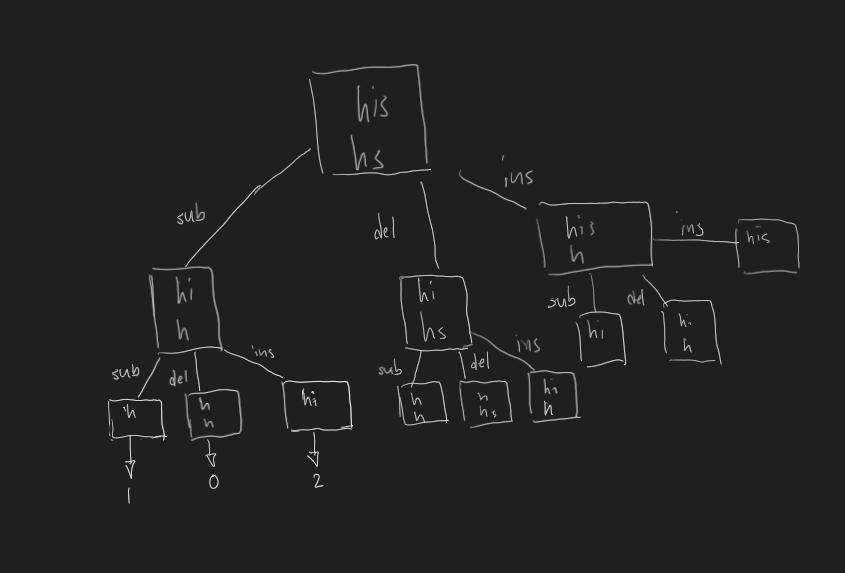
The left branch sub is done first. After that branch is calculated, these is the sate of cache:
cache = {
    (1, 0) = 1
    (1, 1) = 0
    (2, 0) = 2
    (2, 1) = 1
}
Going down the del branch, we eventually hit the ins branch.
This time, instead of recalculating, the value is simply retrieved from cache and returned.
Continuous Optimization#
Find the best vector of real numebrs
$$\large \min_{\large \bold{w} \in \real^d} \text{TrainingError} (\bold w)$$
Algorithmic Tool: Gradient Descent
Example: Finding the least square line#
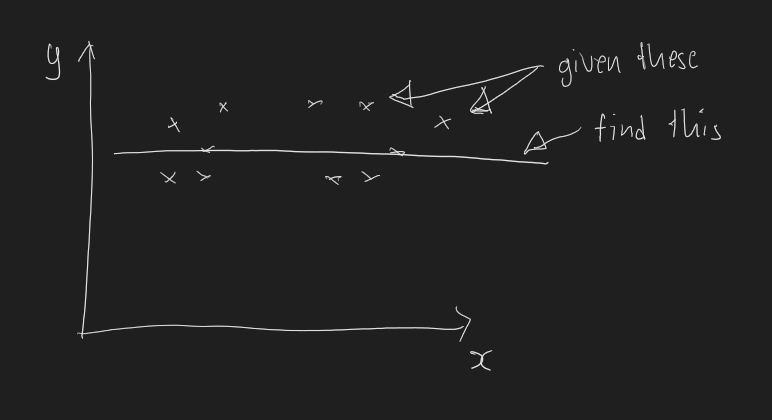
For a set of pairs ${(\large x_1, y_1), … ,(x_n, y_n)}$, find line $\large w \in \real$ that minimizes the error. (assume the line passing thorugh the origin). Error function $\large F(\bold w) = \sum_{i = 1}^{n}(wx_i - y_i)^2$.
Visualised:
Solution: Finding the Least Square Line (Gradient descent)#
Solving this involves recognizing that we are simply trying to minimize the square of the distance from each point to line $w$.
We want $w$ when $\large F(\bold w) = \sum_{i = 1}^{n}(wx_i - y_i)^2$ is at the minimum.
Graphically:
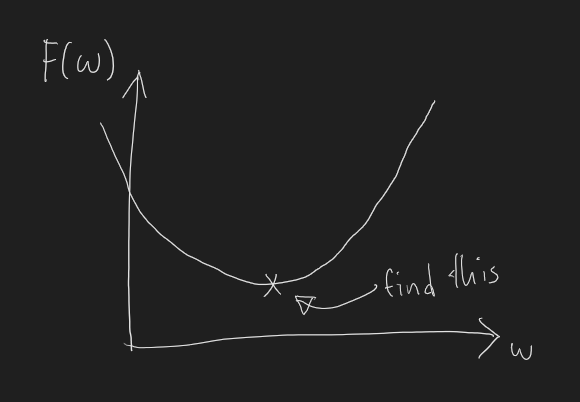
in order to find minimum, calculas will be used.
We will, however, not be finding the gradient in closed form (able to be expressed using a finite number of operations).
Why?
Because not all equations have a closed form.
Instead, we employ Gradient Descent.
Here’s what the algorithm does:
- Pick a random value for $\bold{w}$, say 0
- Move a small step, $\eta$ (read eta), in the direction of the gradient.
- repeat step 1 for $T$ number of times or until the value of the gradient stops changing
points = [(x1, y1), (x2, y2)]

def F(w):
    return sum((w * x - y) ** 2 for x, y in points)

def dF(w):
    return sum(2 * (w * x - y) * x for x, y in points)

def gradientDescent(F, dF):
    w = 0 # choose a random value
    eta = 0.01 # step size eta
    interval = 100 # number of times to repeat, T
    for i in range(interval):
        value = F(w)
        gradient = dF(w)
        w = w - eta * gradient # move in the direction of the gradient
        print(f'interval{i}: w = {w}, F(w): {value}, dF(w)= {gradient}')
Conclusion#
In closing, these two simple optimization will form the foundation in improving the train times of our machine learning algorithms.
Moving forward, specific algorithm aside, here are some general principles when optimizing code:
- abstract away the details
- break down the problem
This was written in python, if you’re interested, here’s a good guide