Machine Learning: an introduction to Reflex based Model
Linear predictors#
A linear predictor is a function that maps an input to an output.
In statistics, the output is known as a response, and the input is a real vector, it is known as the covariate.
Types of Predictors#
Where $f$ is the predictor.
binary classifier
$y$ is either 1 or -1 $ x \rightarrow f \rightarrow y \in {+1, -1}$$
Multiclass Classifier
$y$ is a category $$\textit{Image} \rightarrow f \rightarrow y \in {category}$$
Regression
$y$ is a real number $ x \rightarrow f \rightarrow y \in \real$$
Ranking
$y$ is a permutation $$1, 2, 3, 4 \rightarrow f \rightarrow 2, 3, 1, 4$$
Structured prediction
$y$ is an object built from parts $$\textit{你好} \rightarrow f \rightarrow \textit{how are you}$$
Building blocks of a linear predictor#
Every linear predictor is made up of 4 inter-related parts.
Data
Specifies $y$ as the ground truth output of input $x$
$$(x,y)$$
training data is a multi-set $$\begin{aligned}d_{train} = [&\\&(x_1, y_1),\\&(x_2, y_2),\\&\vdots \\&(x_n, y_n)\\&]\end{aligned}$$
Data gives us a partial specification of what our program should do.
With $d_{train}$ our learning process will look something like: $$ \begin{matrix}&x\\&\downarrow\\d_{train} \rightarrow \text{learner} \rightarrow &f \\ &\downarrow\\&y\end{matrix}$$
This is a good segue into the Model, Inference, Learning paradigm.
Model is how we choose the correct predictor $f$ for a given problem.
Inference is how we compute $y$ given $x$.
Learning is how we use $d_{train}$ to create a Model so that we can do inference.
Feature Extraction
First step in linear prediction.
Take for example, a given string $x$. Predict, $y$, whether the string is a song title.
Feature extraction would be concerned with the question: what part of $x$ is relevant for $y$?
A feature extractor then, returns a set of feature name: feature value pair for each input $x$.
$ \text{sleepwalking} \xRightarrow[\text{arbitrary!}]{\text{Feature Extractor}} \begin{bmatrix}\text{< 5 words:} & 1 \\\text{fracOfAlpha:} & 1 \end{bmatrix} $$
The result of the feature extractor results in a feature vector
Feature Vector
A feature vector can be defined as the list of feature with its associated value.
Mathematically, a feature vector is simply a n by 1 vector.
Based off the previous example:
$$\begin{bmatrix}1\\1\end{bmatrix}$$
After all, the algorithm does not care for the names we give the features, just that the position always correspond to some particular feature.
Formally, a feature Vector is defined as:
$$\phi(x) = [\phi_3(x) + \phi_2(x) + \cdots + \phi_n(x)]$$ $$\text{where } \phi(x) \in \real^d$$
Each data point in the dataset has its own feature vector.
You can think of a feature vector as a point in higher dimensional space.
Weight vector
A weight vector can be defined as a vector of real number $j$ where each value $\bold {w_i}$ represents the contribution of that feature to the prediction.
$ \bold{w} \in \real^d $$
Weight vector applies to the dataset as a whole.
$w_i$ represents the affect that $\phi(x_i)$ has on the final output.
Intuitively, the more positive $w_i$ is, the more positively feature $\phi(_i)$ affects the predictor.
Score
Score on an example is defined as the weighted combination of features.
It indicates how confident we are with our prediction.
$ \bold{w} \cdot \phi (x) = \sum_{j = 1}^{d} \bold{w_j} \phi_j (x), \real^d$$
Putting it together: Linear Predictors#
With Data , Feature Vector , Weight Vector , and score , we can start defining our predictors.
Binary Linear Classifier
$$f_\bold{w}(x) = sign(\bold{w} \cdot \phi (x)) = \begin{cases} +1 &, \text{if } \bold{w} \cdot \phi (x) >= 0 \\-1 &, \text{if } \bold{w} \cdot \phi (x) < 0 \end{cases} $$
The sub-scripted $\bold{w}$ in $f_\bold{w}(x)$ just means that the predictor is dependent on some weight vector $\bold{w}$
In general, binary classifiers $f_\bold{w}(x)$ defines a hyperplane **decision boundary** that is normal to the weight vector $\bold{w}$.
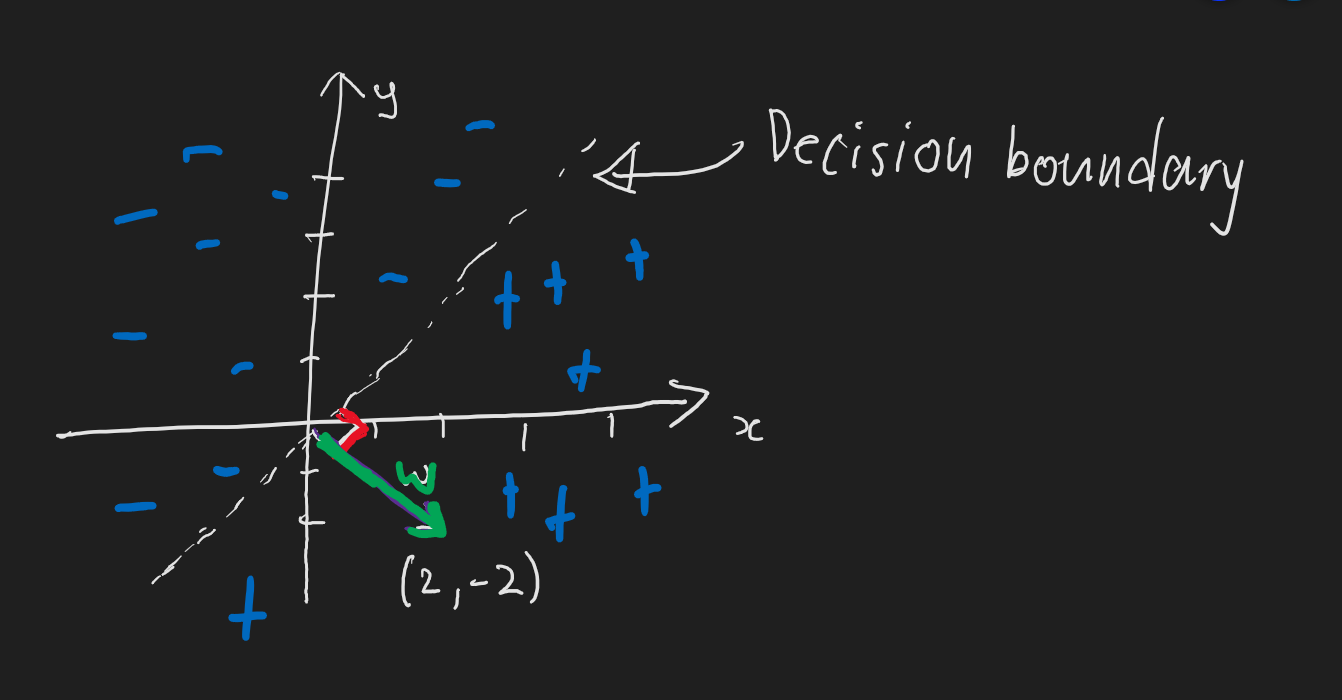
Anything on the side in the direction of the weight vector will be positive, the others will be negative. Those on the line will be the edge cases.
Multiclass classifier
Binary Linear classification can easily be extended to multiclass classifier.
Consider a dataset with R, G, in order to apply multiclass classifier, the dataset is broken up in one of two ways:
- One ve the rest
- R vs G and B
- G vs R and B
- B vs G and R
- One vs One
- R vs G
- R vs B
- G vs B
We then train each dataset independently.
When computing predictions, we score each set and take the highest predicted score to be class the data belongs too.
Learner#
The learner can be said to be in charge of outputting a weight vector for linear classifiers.
The Learning algorithm:
$$\text{Optimization problem} \rightarrow \text{Optimization Algorithm}$$
The former focuses on what we want to compute.
The latter focuses on how we compute what we want.
Loss Minimization#
For the most part, Our optimization problem comes in the form of trying to minimize training loss.
Before we can understand training loss, we need to know about:
- Margins for classifiers
- Residual for regressors
- Loss functions .
Margin#
Margin on an example $(x, y)$ is a measure of how correct we are.
$$(\bold{w} \cdot \phi (x)) y$$
Positive margin means we are correct, negative otherwise.
Normally used in classifiers (Binary classification).
Residual#
Residual is defined as how far a predicted point is from the actual value based on a given $\bold{w}$.
$$(\bold{w} \cdot \phi (x)) - y$$
A positive value means we overestimated, negative means underestimation.
Normally used in the loss functions of regressors (linear regression).
Loss function#
A loss function is defined as how unhappy we would be with $\bold{w}$ if we used it to make a prediction on $x$ when the correct output is $y$.
$$Loss(x, y, \bold{w})$$
loss function is us stating the objective function of how we want to train our model
0 Loss is the best we can hope for.
Classifier Loss Functions#
0-1 Loss function
$$\begin{matrix} Loss_{0-1}(x, y, \bold{w}) &=& 1\left[ f_{\bold{w}}(x) \neq y \right] \\&=& 1 \left[(\bold{w} \cdot \phi (x)) y < 0 \right] \end{matrix}$$
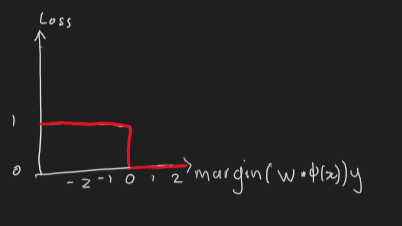
Returns 0 if the prediction is correct, 1 otherwise.
Normally used with binary classifier.
Unfortunately, this equation won’t work with gradient descent algorithms since the gradient is 0 everywhere, except at 0.
Hinge Loss
Fixes the problem that 0-1 Loss has with iterative optimization (gradient descent).
$$Loss_{hinge} (x, y, \bold{w})= \max {1 - \bold{w} \cdot \phi (x)y, 0}$$
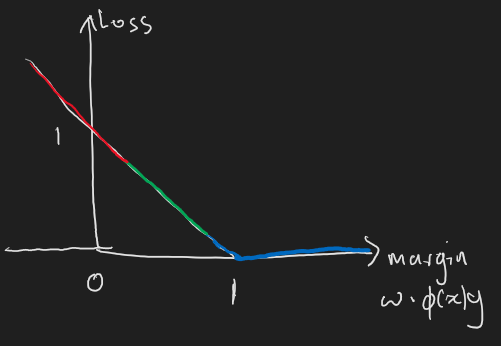
The differential of $Loss_{hinge} (x, y, \bold{w})$:
$$\nabla_{\bold{w}} Loss_{hinge} (x, y, \bold{w}) = \begin{cases} 0 &, \text{if } \bold{w} \cdot \phi(x) y > 1 \\ - \phi (x)y &, \text{if } \bold{w} \cdot \phi(x) y < 1 \end{cases}$$
Noticed that there is nothing for when margin is 1 because $Loss_{hinge} (x, y, \bold{w})$ is not differentiable at that point.
In iterative optimization, the $Loss_{hinge} (x, y, \bold{w})$ will try to increase margin if it is less than 1.
Logistic Regression
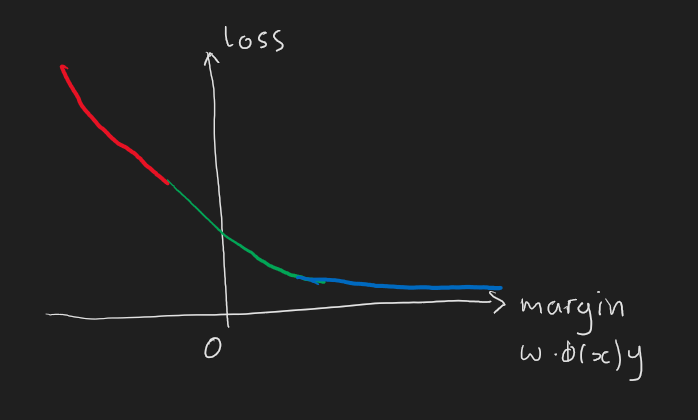
$$Loss_{logistic} (x, y, \bold{w}) = \log (1 + e^{-\bold{w} \cdot \phi (x) y})$$
The main difference between logistic regression and Hinge loss is the non-zero loss that logistic regression dishes out no matter the margin
As such, iterative optimization algorithms has an incentive to keep increasing margins (although a diminishing one).
Regression Loss Functions#
Square Loss
$$Loss_{square}(x, y, \bold{w}) = (\bold{w} \cdot \phi (x) - y)^2$$
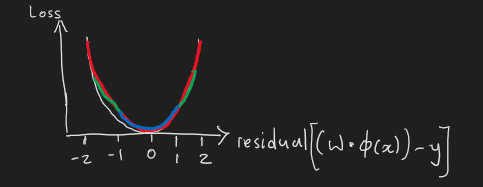
Predictions will tend towards the mean. Tries to accommodate every point.
Normally used with linear regression.
Absolute deviation Loss
$$Loss_{square}(x, y, \bold{w}) = |\bold{w} \cdot \phi (x) - y|$$
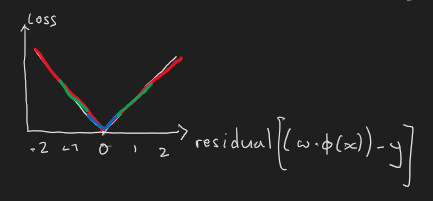
Predictions will tend towards the median. More robust to outliers
Can be hard to optimize for due to the kink about its turning point which is cannot be differentiated.
Normally used with linear regression
Huber Loss
Combines the absolute deviation loss and the square loss.
No kinks at turning point, grows linearly instead of quadratically
TrainLoss#
TrainLoss is defined as the averaged $Loss(x, y, \bold{w})$ on a given data set. $$TrainLoss = \frac{1}{|D_{train}|} \sum_ {(x, y) \in D_{train}} Loss(x, y, \bold{w})$$
As such, we can now define loss minimization as the value of $\bold{w}$ such that $TrainLoss(\bold{w})$ is a minimum: $$ \min_{ \bold{w} \in \real^d} TrainLoss(\bold{w})$$
For 1 dimensional $\bold{w}$, things will look something like:
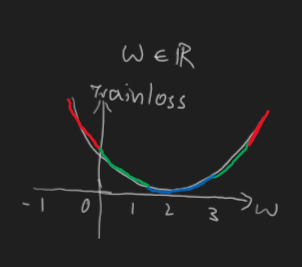
In which case, the value for $\bold{w}$ will be somewhere close to 2.
2 dimensional $\bold{w}$ will look something like:
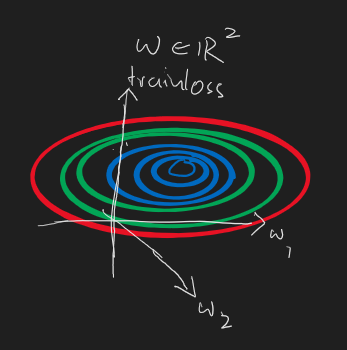
In which case, the value of $\bold{w}$ will be $\begin{pmatrix}\bold{w_1} \ \bold{w_2}\end{pmatrix}$ where the values of $\bold{w_1}$ and $\bold{w_2}$ will be at the middle of the smallest blue circle.
Stochastic Gradient Descent#
Generating Artificial Data#
As an aside, testing is a crucial aspect, so here are some ways to generate random data.
For Regressors:
true_w = np.array([1, 2, 3, 4, 5, ... n])
d  = len(true_w)
points = []
num_of_points = 10000
for i in range(num_of_points):
    x = np.random.randn(d) # creates a random array populated by normal distribution with mean 0 and variance 1
    y = w.dot(x) + np.random.randn() # a single random number
    points.append((x, y))
For Binary Classifiers:
def classify(score):
    if score > 0:
        np.random.rand() < 0.1: # adding misclassification
            return -1
        return 1
    else if score < 0:
       np.random.rand() < 0.1:
            return 1
        return -1

true_w = np.array([1, 2, 3, 4, 5, ... n])
d  = len(true_w)
points = []
num_of_points = 10000
for i in range(num_of_points):
    x = np.random.randn(d)
    y = classify(w.dot(x))
    points.append((x, y))
Gradient#
One important concept here is gradient $\nabla_{\bold{w}}TrainLoss(\bold{w})$.^
Gradient represents the direction that increases the loss the most.
^ The symbol is Nabla and it represents differentiating $TrainLoss(\bold{w})$ with respect to $\bold{w}$.
Revisiting Gradient Descent#
We’ve looked at Gradient Descent before.
In order to find the value of $\bold{w}$ that minimizes $TrainLoss(\bold{w})$, we use iterative optimization.
This iterative optimization process is known as gradient descent and has two hyper-parameters
- Step size $\eta$
- Number of iteration $T$
Formally, gradient descent can be represented as: $$\begin{aligned}&\text{Initialize } \bold{w} = [0 \cdots 0] \\&\text{For } T = 1 \cdots T; \\& \space \space \space \space \bold{w} \leftarrow \bold{w} - \eta \nabla_\bold{w} TrainLoss(\bold{w}) \end{aligned}$$
A more general gradient descent algorithm that extends to $\bold{w} \in \real^d$ can now be coded up for least square regression:
point = [(np.array([1, 2, 3, ... n]), 4), (np.array([1, 2, 3, ... n]), 5)]
def F(w):
    return sum((w.dot(x) - y) ** 2 for x, y in points) / len(points)

def dF(w):
    return sum(2 * (w.dot(x) - y) * x for x, y, in points) / len(points)

def gradientDescent(F, dF, d):
    w = np.random.randn(d)
    eta = 0.01
    interval = 1000
    for t in range(interval):
        value = F(w)
        gradient = dF(w)
        w = w - eta * gradient
        print(f'interval {t}: TrainLoss = {value}, gradient = {gradient}, w = {w}')
The problem with gradient descent#
One problem (but not the only problem) with gradient descent is that it is slow.
In particular, the slowness here arises from trying to train large scale data in the millions. (Which is modest as of 2020 standards)
Each gradient calculation has to sum over all existing feature points before we can even move the weight vector closer to the minimum even once.
Stochastic Gradient Descent’s Insight#
The insight is that $TrainLoss(\bold{w})$ is merely the average of $Loss(x, y, \bold{w})$ from each individual data point in $D_{train}$.
This means that $Loss(x, y, \bold{w})$ for one or some subset of the data point is partially representative of $TrainLoss(\bold{w})$.
Hence, instead of waiting to calculate $TrainLoss(\bold{W})$, we simply calculate $Loss(x, y, \bold{w})$ and march in the opposite of that direction.
Formally stochastic gradient descent is: $$\begin{aligned}&\text{Initialize } \bold{w} = [0 \cdots 0] \\&\text{For } T = 1 \cdots T: \\& \space \space \space \space \text{For an } (x, y) \text{ in } D_{train}:\\& \space \space \space \space \space \space \space \space \bold{w} \bold{w} - \eta \space \nabla_\bold{w} Loss(x, y, \bold{w})\end{aligned} $$
Deciding Step Size#
Step size determines how fast we move in the direction towards what we think is the minimum.
For SGD, step size becomes even more important because the steps we are taking are noisier.
Here’s a visual of what step-sizes are like:
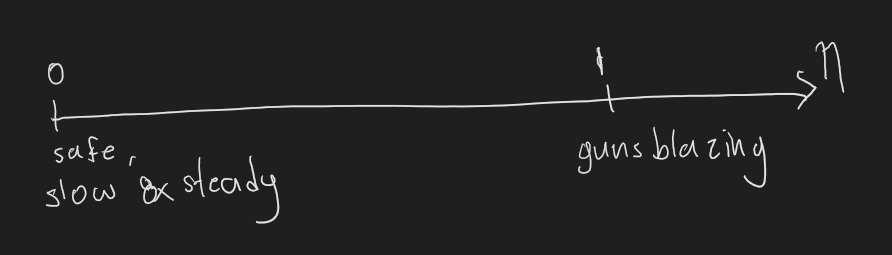
Some strategies:
- Constant $\eta$
- Decreasing $\eta$
- $\eta = \frac{1}{\sqrt{\text{Number of updates}}}$
- $\eta = \frac{1}{\text{Number of updates}}$
Putting it together: SGD#
point = [(np.array([1, 2, 3, ... n]), 4), (np.array([1, 2, 3, ... n]), 5)]
def least_squared_loss(w, i):
    x, y = points[i]
    return (w.dot(x) - y) ** 2
def dLeast_squared_loss(w, i):
    x, y = points[i]
    return 2 * (w.dot(x) - y) * x

def stochastic_gradient_descent(F, dF, d, n):
    w = np.zeros(d)
    eta = 1
    num_updates = 0
    interval = 10000
    for t in range(interval):
        for i in range(n): # Updating weights based on each training data
            value = least_squared_loss(w, i)
            gradient = dLeast_squared_loss(w, i)
            num_updates += 1
            eta = 1.0 / num_updates # adjusting step_size to become smaller as we get closer to minimum point
            w = w - eta * gradient
        print(f'interval {t}: f(w) = {value}, dF(w) = {gradient}, w = {w}')